Best Wilderness First Aid Kits for Backpacking 2026
The best wilderness first aid kits for backpacking in 2026, tested and ranked by trip length, weight, and what actually matters when you're miles from help.

This post may contain affiliate links. Disclosure
You’re two days into a backcountry loop when your partner rolls an ankle on a talus slope. The nearest trailhead is eight miles back. What’s in your pack decides what happens next. A drug-store first aid kit with 40 adhesive bandages and a sheet of instructions won’t cut it — and neither will an overpacked expedition kit that weighs as much as your shelter system. The gap between a kit that keeps you safe and one that only looks reassuring can cost you dearly when it matters most.
This guide cuts through the noise. We’ve broken down seven of the best wilderness first aid kits for backpacking by trip length, group size, and weight-to-protection ratio — so you pick the one that actually fits your adventure, not your anxiety.
Short answer: Standard first aid kits assume an ambulance is ten minutes away; wilderness kits assume hours or days of self-reliance. That means wound irrigation syringes, moleskin for blisters, elastic bandages for splinting, hemostatic gauze for serious bleeds, and a written field guide that works without a signal. Skill matters more than contents.
Why a Wilderness Kit Is Fundamentally Different
Standard first aid kits are designed for environments where EMS is 10 minutes away. Wilderness kits assume hours or days of self-reliance. That means they include items like wound irrigation syringes, moleskin for blister management, elastic bandages for splinting, QuikClot gauze for serious bleeds, and written field guides that walk you through procedures without cellular service.
The Wilderness Medical Society defines a wilderness emergency as any situation where definitive care is more than one hour away — which covers most backpacking scenarios. Equipping yourself accordingly isn’t paranoia; it’s trip planning.
Look for these non-negotiables in any backcountry kit: a wound closure system (butterfly strips or adhesive closures), irrigation syringe (30-60ml), elastic wrap, moleskin, an emergency reference guide, and basic medications (ibuprofen, diphenhydramine, antacid). Everything else is additive.
 Photo by Roger Brown on Pexels
How We Ranked These Kits
Each kit was evaluated on five criteria: supply quality (are items medical-grade?), assortment (right tools for backcountry scenarios?), weight and packability, organization (can you find what you need under stress?), and value relative to protection level. Kits were cross-referenced against protocols from the National Outdoor Leadership School (NOLS) Wilderness Medicine curriculum.
Best Wilderness First Aid Kits for Backpacking 2026
1. Adventure Medical Kits Ultralight/Watertight .7 — Best Overall for Solo to Small Groups

The verdict: The gold standard for 1-3 person trips up to three days. It hits every technical checkbox at a weight that won’t make you leave it home.
Who it’s for: Solo hikers and pairs on weekend to three-day backcountry trips who want a purpose-built kit without excess bulk.
Specs at a glance:
- Weight: 8 oz
- Capacity: Covers 1-3 people, up to 3 days
- Waterproofing: DryFlex inner bag + water-resistant outer
- Price: around $45
What’s inside: Wound closures, irrigation syringe, elastic wrap, moleskin, antiseptic wipes, gauze pads, trauma pad, over-the-counter medications (ibuprofen, antihistamine, antacid), and a wilderness first aid guide.
The real strength of this kit is the DryFlex inner bag — your supplies stay dry in creek crossings and rain without adding meaningful weight. The contents are thoughtfully selected rather than padded with low-value items. Gear Junkie named it Best Overall for solo and small group use.
Limitation: The .7 is sized for short trips. For groups larger than two or trips over three days, step up to the .9 or Mountain Series.
2. Adventure Medical Kits Mountain Series Backpacker — Best for Multi-Day Trips
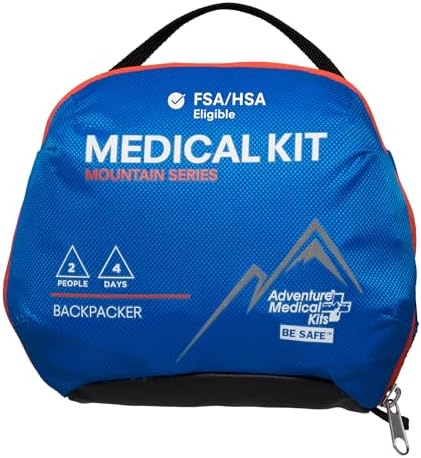
The verdict: 96 pieces, sized for two people over four days, with a large trauma pad and elastic bandage that make it capable of handling real backcountry injuries.
Who it’s for: Pairs or solo backpackers on 3-5 day routes who want genuine treatment capability — not just blister and scratch coverage.
Specs at a glance:
- Weight: 14 oz
- Capacity: 2 people, up to 4 days, 96 pieces
- Organization: Easy Care labeled pockets
- Price: around $55
What’s inside: Everything in the Ultralight .7 plus a large trauma pad for serious wound management, a full elastic bandage for sprain/fracture stabilization, extra wound closures, and a more comprehensive medication selection. The included Wilderness First Aid Guide is the same field-tested NOLS-aligned reference used across the AMK lineup.
The Easy Care organizational system — labeled, color-coded pockets — is underrated. When someone’s hand is bleeding and your adrenaline is up, clear labeling matters. OGL highlighted this kit as a strong pick for backcountry trips.
Limitation: At 14 oz it’s not ultralight. For base-layer pack-weight obsessives on longer trips alone, the .7 is more efficient. But for genuine multi-day capability, this is the right call.
3. MY MEDIC MyFAK PRO Tactical IFAK — Best for Remote Expeditions and Trained Users
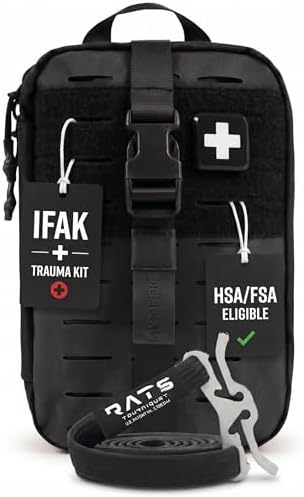
The verdict: A professional-grade IFAK (Individual First Aid Kit) built for people who have taken a wilderness first responder course and need real trauma tools in the field.
Who it’s for: Expedition leaders, solo long-distance backpackers on technical routes, overlanders, and anyone with wilderness first responder (WFR) or similar training.
Specs at a glance:
- Weight: 31 oz
- Contents: 140+ items
- MOLLE compatible, tear-away panel
- Built in the USA
- Price: around $180
What’s inside: Tourniquet, emergency pressure bandage, compressed gauze, EMT shears, space blanket, burn gel, blister strips, irrigation supplies, gloves, splint, and a full medication selection. Every item is medical-grade and assembled by hand in a US facility.
The MOLLE panel and tear-away design aren’t gimmicks — fast access under stress is a design requirement for a kit at this level. MyFAK Pro was highlighted by Gear Junkie for car camping and expedition scenarios where weight is secondary to capability.
Limitation: At nearly two pounds and $180, this is not a weekend day-hike kit. Without proper training, some items will be unusable or even counterproductive. Take a WFR course before relying on trauma-level gear.
4. Surviveware 238-Piece Comprehensive First Aid Kit — Best for Basecamp and Group Trips

The verdict: When you’re running a basecamp, guiding a group, or car-camping at the trailhead as a launch point, this 238-piece kit covers every conceivable scenario without the expedition price tag.
Who it’s for: Group leaders, car campers at trailhead base, guides, and families on overlanding or extended camping trips.
Specs at a glance:
- Weight: 16 oz (packed in rugged 600D polyester case)
- Pieces: 238
- MOLLE compatible, removable CPR kit
- Water-resistant and rip-resistant case
- Price: around $75
What’s inside: Multiple bandage sizes, hospital-grade trauma shears, forceps, CPR mask (removable), irrigation supplies, wound closure strips, antiseptics, medications, and elastic wraps — all organized in labeled, laminate-protected inner pouches.
The removable CPR kit is a feature worth noting: it means you can pull the most critical emergency tool instantly without digging through the main kit. Internal laminate pouches keep individual supplies organized and protected even after repeated use. OutdoorGearLab highlighted the Surviveware Small for its hospital-grade forceps and quality construction.
Limitation: At this piece count and case size, this is a group asset, not a personal carry for a solo overnight. Pack it at camp and take your personal lightweight kit on day hikes from base.
5. Adventure Medical Kits Mountain Series Hiker — Best Budget Day-Hike Kit

The verdict: For day hikes and single overnights, the AMK Hiker delivers everything you actually need at 10 oz and around $35 — the most sensible entry point for backcountry safety on a budget.
Who it’s for: Day hikers, trail runners, and beginners building out their kit for the first time.
Specs at a glance:
- Weight: 10 oz
- Capacity: 2 people, up to 2 days
- Price: around $35
What’s inside: Bandages, moleskin, tick tweezers, trauma shears, antiseptics, over-the-counter medications, and a wilderness first aid guide. Compact enough to fit in a hip-belt pocket.
OGL rated this the best outdoor value kit for day trips. Tick tweezers are a specific inclusion that most basic kits skip — a meaningful difference if you’re hiking in the eastern US where Lyme disease risk is real.
Limitation: Minimal quantities mean you’ll need to restock after heavier use. Not rated for more than two people or two days.
 Photo by Thirdman on Pexels
Trip-Length Decision Framework
Matching your kit to your trip is the core decision. Here’s a quick guide:
Day hikes (under 12 hours out): AMK Hiker or the .3 Ultralight/Watertight. Emphasis on blister treatment, wound closure, and OTC medications. Weight target: under 6 oz.
Weekend trips (1-3 days): AMK Ultralight/Watertight .7. Full wound management, elastic wrap, irrigation, medications. Weight target: 6-10 oz.
Multi-day (4-7 days): AMK Mountain Series Backpacker. Add a larger trauma pad, more elastic bandage length, and expanded medications. Weight target: 10-16 oz.
Remote expeditions (7+ days, technical terrain): MyFAK PRO or an equivalent IFAK system, supplemented with prescription medications from a travel medicine provider. Consider adding a satellite communicator as a critical companion to any kit beyond the three-day tier.
Packing Your Kit: Weight and Organization Tips
Knowing what’s in your kit matters as much as having it. Two organizing principles make a real difference in the field.
Keep your most-used items at the top. Moleskin and blister supplies are the most-reached-for items on most backpacking trips, not trauma gear. Organize by frequency of use, not severity of scenario. If your kit is a stuff sack, a small zip pouch inside the main kit keeps blister supplies immediately accessible without emptying everything.
Weigh your kit once a season. Hydrated gauze pads, expired medications, and partially used moleskin sheets add weight without adding value. A five-minute audit every spring trip resets your kit and reveals what you actually used the previous season — valuable feedback for calibrating how much of each item to carry.
Separate the critical from the routine. For kits above the AMK .7, consider a small inner pouch for trauma-critical items: tourniquet, compression bandage, QuikClot. These need to be findable in seconds, not excavated from the main kit under stress.
What to Add to Any Commercial Kit
No off-the-shelf kit is perfect. These four additions cost under $20 total and meaningfully extend any kit’s capability:
- SAM splint: Moldable foam/aluminum splint for fractures and sprains. Under 2 oz folded.
- Bleed stop gauze: QuikClot or Celox for severe hemorrhage control. One packet.
- Prescription antibiotics: Discuss with your doctor or a travel medicine clinic before any remote trip. Amoxicillin-clavulanate covers most backcountry wound infections.
- Epinephrine auto-injector: If you have any history of anaphylaxis, this is non-negotiable regardless of kit tier.
Skill Is the Most Important Item in Your Kit
Even the most comprehensive commercial kit is only as useful as your ability to use it. The American Red Cross offers Wilderness First Aid certification in two-day courses available nationwide. If you’re planning technical routes, multi-day expeditions, or guiding others, a full Wilderness First Responder (WFR) course from NOLS or SOLO Schools is the standard.
Gear is the backup. Knowledge is the primary tool. For more on building a complete backcountry safety system, see our adventure travel safety guide and adventure travel health guide.
Final Verdict
For most backpackers on weekend to three-day trips, the AMK Ultralight/Watertight .7 is the clear answer: compact, watertight, properly stocked, and under $50. Step up to the Mountain Series Backpacker for groups or longer routes, and to the MyFAK PRO if you have the training and the terrain demands it.
Whatever you choose, bring it. An unopened kit still at the trailhead is the worst outcome.
Related Reading
Get price-drop alerts and new guides from BoldTripGuide
One email a week: price drops on the gear we recommend, new guides, and what changed. No spam, unsubscribe anytime.