Best Winter Desert Hiking Destinations: 7 Picks (2026)
Seven winter desert hikes — Death Valley to Wadi Rum. Cold-night temps in °F, water-carry math, permit costs, GPS, and the gear that keeps you alive.

This post may contain affiliate links. Disclosure
Winter is when the desert finally lets you in. Summer surface temps on Death Valley slickrock crack 180°F and shut every serious route between May and October. From November through February the same trails drop into the 50-70°F daytime sweet spot — long shadows, hard light, zero heatstroke risk. The tradeoff is overnight lows that flirt with freezing and, at elevation, drop into the teens. This guide covers seven of the planet’s best winter desert hikes — five in the American Southwest, two abroad — with exact permit costs, GPS coordinates, water-carry math (3-4L/day in winter vs 6-8L summer), cold-night temperatures, and the layering kit that keeps you out of a hypothermia evacuation.
Short answer: Winter is the only sensible desert hiking season. Summer surface temperatures on Death Valley slickrock crack 180°F, and the CDC logs an average of 90 heat-related deaths a year across US national parks. From November through March the same trails sit at 50-75°F by day, with overnight lows near freezing.
Why Winter Is the Only Sensible Desert Season
The Mojave, Sonoran, Chihuahuan, and Atacama are deathtraps from May through September. The CDC logs an average of 90 heat-related deaths per year in U.S. national parks, with Death Valley, Grand Canyon, and Big Bend topping the list every season. The fix is calendrical, not technical: shift the same hikes to November-March and the risk profile inverts. Daytime highs land between 50°F and 75°F across most southwestern desert parks. The cost: nighttime lows in the 20s-40s°F, occasional snow at elevation, and shorter daylight (sunset around 5:00 p.m. in December). Your gear math changes accordingly — less water, more insulation, headlamp non-negotiable.
A second reason: winter is the only time you can do long-mileage desert hikes (15+ miles) without splitting them into 4 a.m. pre-dawn starts. South Rim in Big Bend, Telescope Peak in Death Valley, Wadi Rum’s Jebel Burdah scramble — all become single-push day hikes when daytime temps cap at 65°F. Summer turns them into multi-day expeditions or kills you. For broader risk frameworks across desert and mountain terrain, our adventure travel safety guide covers the protocols.
Where to Hike This Winter
1. Death Valley National Park — California
The lowest, hottest place in North America becomes the most comfortable winter desert in the country between mid-November and mid-March. Daytime highs at Furnace Creek (-190 ft elevation) average 65-75°F in December-January; overnight lows sit between 38-50°F in the valley. The headline routes: Telescope Peak (14 miles round-trip, 3,000 ft gain to an 11,049 ft summit; expect snow and 20°F windchill at the top December through April), Mosaic Canyon (4 miles, polished marble narrows, kid-friendly), and Golden Canyon to Zabriskie Point (6 miles loop through badlands).
Permit & Cost: Park entrance is $30/vehicle for 7 days. No day-hike permits. Wilderness/backcountry overnight permits are free but mandatory — register at Death Valley wilderness permits. $4/permit recreation fee for the Cottonwood-Marble Canyon loop.
Best Season: November-March. Avoid the valley floor April-October — surface temps on slickrock exceed 150°F by 10 a.m.
Water-Carry Math: 3 liters for half-day desert hikes in winter, 5 liters for full-day routes above 5,000 ft. Telescope Peak in January requires 4 liters plus the ability to melt snow if you bivy.
Required Gear: Insulated layers (down puffy + windshell minimum for Telescope), microspikes November-April for upper Telescope, and a Garmin inReach Mini 2 — cell signal is nonexistent across 90% of the park’s 3.4 million acres.
 Photo via Pexels
2. Big Bend National Park — Texas
Big Bend is the most underrated winter hiking destination in North America. The park sits in far west Texas at the Mexican border, 240 miles from the nearest commercial airport, which keeps crowds low even in peak season. The crown jewel is the South Rim Trail Loop: 12-14 miles depending on the variant, 2,000 ft gain into the Chisos Mountains, with the southernmost 1,500 ft cliff edge in the U.S. opening onto views across the Chihuahuan Desert into Mexico (GPS trailhead: 29.2702, -103.3008).
Permit & Cost: $30/vehicle entrance for 7 days. Day hikes free. Backcountry permits $10 + $6/person/night via NPS Big Bend backcountry permits. South Rim Trail closes its Northeast Rim spur February 1-May 31 for nesting peregrine falcons — the main south-facing rim stays open year-round.
Best Season: December-March. December highs average 62°F at the visitor center, lows 36°F; January is colder with highs of 61°F and lows of 35°F. Documented winter overnight lows in the Chisos Basin (5,400 ft) hit 20°F regularly — water bottles freeze solid by 4 a.m.
Water-Carry Math: 3 liters for the South Rim day hike in December-January. Springs along the route are unreliable — treat any source you find as a bonus, not a plan.
Required Gear: 20°F-rated sleeping bag if you bivy, hard-shell jacket for ridgeline wind, and a reliable headlamp — sunset at the South Rim in December is 5:35 p.m. and the descent to the Basin takes 3+ hours. See our best headlamps for night hiking guide for current picks.
3. Joshua Tree National Park — California
Joshua Tree is the most accessible winter desert hike in the country — 2.5 hours from LA, 3 from Vegas, and the trail network supports everything from 30-minute family loops to 16-mile traverses. The signature winter routes: Ryan Mountain (3 miles round-trip, 1,050 ft gain to a 5,461 ft summit with 360-degree park views, GPS: 33.9893, -116.1390), Lost Palms Oasis (7.2 miles round-trip from Cottonwood Spring), and 49 Palms Oasis (3 miles round-trip to a hidden fan palm grove).
Permit & Cost: $30/vehicle entrance for 7 days. No day-hike permits. Backcountry camping is free with a self-registration permit at any of 13 backcountry boards.
Best Season: November-April. Daytime highs hold at 60-70°F November-February, climbing to 80-90°F by March-April. Overnight lows in the 30s-40s°F are routine; high-desert nights below 30°F happen 8-12 times per winter, with rare dustings of snow at Ryan Mountain summit.
Water-Carry Math: 2.5-3 liters for any day hike up to 8 miles. Lost Palms Oasis stop has zero shade on the return — carry an extra 0.5 liter buffer.
Required Gear: Layering is the game — start in a fleece + windshell at 8 a.m., strip to a sun hoody by noon, layer back up at 4 p.m. The park’s bouldering-grade granite eats trail-running shoes; mid-cut hiking boots last longer. Joshua Tree is also one of the best dark-sky stargazing destinations on the continent — bring a red headlamp for night photography.
4. Wadi Rum — Jordan
Wadi Rum is what Death Valley would be if you turned the sandstone orange and dropped Lawrence of Arabia into it. The 280-square-mile protected area in southern Jordan is administered by the Zalabia Bedouin and offers a trekking network that ranges from 1-day scrambles to 7-day traverses. The marquee winter routes: Jebel Burdah Rock Bridge (5-6 hour scramble with class 3 moves; Bedouin guide mandatory), Jebel Khazali slot canyon (half-day), and the 3-day Wadi Rum traverse from Disi to Burrah Canyon.
Permit & Cost: $7 USD entrance fee at the visitor center (50 JD discount with Jordan Pass — buy the Jordan Pass for $99 USD which includes Petra). Guided trek pricing through Bedouin operators: $80-120/day for 1-day; $250-400/person for multi-day all-inclusive (camp, meals, jeep transfer).
Best Season: October-April. January daytime highs average 59°F, nights drop to 39°F at the canyon floor and the high 20s°F at exposed bivy sites. December and January are the coldest months but offer the clearest skies for stargazing in one of the largest dark-sky reserves on Earth.
Water-Carry Math: 4 liters per person per day in winter (vs 6-8L in summer); Bedouin guides resupply from cisterns on multi-day treks. Solo hiking without a guide is officially permitted but strongly discouraged — there is no marked trail system and rescue is hours away.
Required Gear: 20°F sleeping bag for January overnights, gaiters for sand, sun hoody and sunglasses (winter UV at this latitude is still aggressive), and headtorch with 200+ lumens. Sunrise is 6:45 a.m. and sunset 5:00 p.m. in January — daylight is short. For more on this region see our Oman adventure travel guide which covers the adjacent Arabian Peninsula deserts.
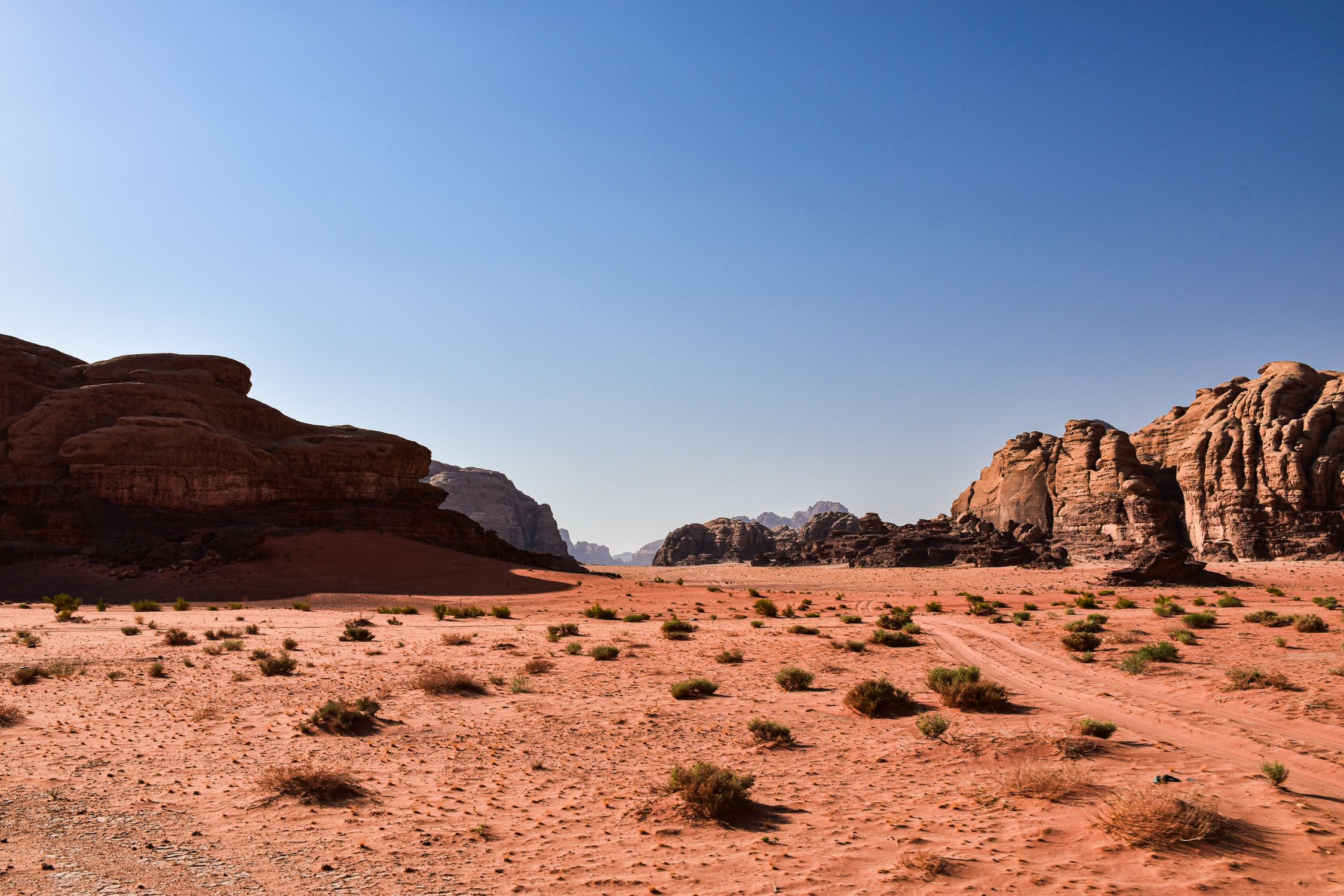 Photo via Pexels
5. Anza-Borrego Desert State Park — California
The largest state park in California (600,000 acres) gets a fraction of Joshua Tree’s traffic and offers the same Sonoran Desert ecosystem with more solitude. The headline hike is Borrego Palm Canyon (3 miles round-trip, 700 ft gain to California’s third-largest palm oasis with a seasonal stream and resident desert bighorn sheep; trailhead GPS: 33.2719, -116.4117). Other winter classics: Maidenhair Falls (4 miles round-trip in Hellhole Canyon), Wind Caves (1 mile round-trip to wind-eroded sandstone hoodoos in the Carrizo Badlands), and the Calcite Mine Slot Canyon (4-5 miles).
Permit & Cost: $10/vehicle day-use fee at the Palm Canyon parking area. Camping at Borrego Palm Canyon Campground $25-35/night. Backcountry/dispersed camping is free across most of the park — see Anza-Borrego State Park for current regulations.
Best Season: November-March. December-January daytime highs sit at 65-72°F, overnight lows 38-48°F in the valley. February-March brings the bonus of desert wildflower super-blooms in El Niño years (last major bloom: 2019, partial in 2023).
Water-Carry Math: 2 liters for Borrego Palm Canyon, 3 liters for any 5+ mile route. The seasonal stream in Palm Canyon is not potable without treatment.
Required Gear: Sturdy day pack, sun hat, and the standard desert hiking kit from our packing guide. Bighorn sheep are most active at dawn — bring binoculars.
6. Atacama Desert — Chile
The driest non-polar desert on Earth, the Atacama trekking circuit is centered on the village of San Pedro de Atacama (elevation 2,400 m / 7,900 ft). December is austral summer — daytime highs in San Pedro hover at 75-80°F, dropping below freezing at altitude. The key day hikes: Valle de la Luna (Moon Valley, 5-7 km loop through salt formations; trailhead 22 km from San Pedro), Quebrada de Guatín (cactus-lined river canyon, 6 km), and the punishing Cerro Toco acclimatization climb (5,604 m / 18,380 ft summit; only attempt after 4-5 days at altitude).
Permit & Cost: Most trails have small entrance fees in the $5-15 USD range, paid at trailheads or through Conaf (Chile’s park service). Valle de la Luna is part of Los Flamencos National Reserve — $10 USD entrance. Guided treks through San Pedro operators: $30-80/person/day. See SERNATUR Chile for official tourism info.
Best Season: April-November (Chile’s winter/dry season) is the optimal trekking window despite the name; December-March is austral summer with occasional Altiplanic Winter thunderstorms (afternoon rain bursts December-March). For northern-hemisphere “winter” travelers, December offers stable mornings and afternoon storm risk above 4,000 m.
Water-Carry Math: 4 liters per person per day at altitude — dehydration accelerates altitude sickness dramatically. Acetazolamide (Diamox) prophylaxis is standard for the Cerro Toco summit push.
Required Gear: Down jacket and hard shell for any objective above 4,000 m (sunrise temps at El Tatio Geysers, 4,320 m, hit -10°C / 14°F regularly), wraparound sunglasses (UV index of 11+ at altitude under thin atmosphere), and trekking poles. Cell signal is reliable in San Pedro itself but absent across most trekking objectives.
7. Goblin Valley & San Rafael Swell — Utah
Goblin Valley is the gateway. The state park’s main valley (GPS: 38.5697, -110.7081) is a 3-square-mile field of mushroom-shaped hoodoos you can walk freely through — no marked trail, no permit beyond the $20/vehicle state park entrance fee. The adjacent Little Wild Horse Canyon (8-mile loop with Bell Canyon) is the best beginner slot canyon in Utah, hikeable December-March without flash flood risk. For a longer winter objective, Crack Canyon in the San Rafael Reef (5-6 miles round-trip) offers slot scrambling and zero crowds. See our slot canyon hiking guide for the full Utah slot beta.
Permit & Cost: Goblin Valley State Park $20/vehicle day-use. Little Wild Horse and Crack Canyon (BLM land) free, no permit. Camping at Goblin Valley campground $35/night; free dispersed BLM camping along Goblin Valley Road. See BLM Utah for current land status.
Best Season: November-March for slot canyons (zero flash flood risk in winter). Daytime highs 45-60°F, overnight lows 18-30°F in December-January. The hoodoos cast their best photo light October-November and February-March.
Water-Carry Math: 2 liters for any day hike under 6 miles in winter. Slot canyons stay cold and shaded — pack a thermos with hot tea for lunch stops.
Required Gear: Insulated layers, waterproof shoes (Little Wild Horse has minor wet crossings in winter), and trekking poles. Overnight bivy in the Swell requires a 0°F sleeping bag for January.
The Winter Desert Layering System
The single largest gear difference between summer and winter desert hiking is the layering kit. Daytime swings from 30°F at sunrise to 70°F at noon are routine. The system that works:
- Base layer: Merino wool 150-weight long sleeve (Smartwool, Icebreaker, or Ridge Merino).
- Mid layer: Lightweight fleece (Patagonia R1 Air or equivalent).
- Insulation: 800-fill down puffy (Patagonia Down Sweater, Mountain Hardwear Ghost Whisperer, or REI 650 Down).
- Shell: 2.5-layer rain/windshell. Even in the desert — windchill at exposed ridgelines crushes you.
- Bottoms: Convertible hiking pants over merino long underwear for sub-40°F starts.
- Extras: Beanie, fleece gloves, lightweight gaiters for sand and slot canyon scree.
Strip layers aggressively as the sun comes up; layer back up at any rest stop longer than 10 minutes. Cotton kills in the desert in winter — sweat-soaked cotton plus a sundown windchill is the fastest path to hypothermia in this terrain.
The Cold-Night Cooking and Water Plan
Below 35°F your hydration bladder hose freezes within 90 minutes. Below 25°F your water bottles develop ice shells. Three fixes:
- Carry insulated water bottles (Hydro Flask wide-mouth 32oz, or Nalgene with neoprene sleeve).
- Sleep with your water bottles inside the sleeping bag overnight.
- Boil water for breakfast and pour 0.5 liter directly into your insulated bottle for warm hiking water through lunch.
Stove-wise: a canister stove (MSR PocketRocket Deluxe, Soto WindMaster) works fine down to ~20°F with isobutane fuel. Below 20°F switch to a liquid-fuel stove (MSR WhisperLite Universal) or pre-warm the canister inside your jacket for 10 minutes. White gas is the backup for any winter trip below 10°F.
How to Pick a Destination
If you’ve never done a winter desert hike, start with Joshua Tree or Anza-Borrego — both are within 3 hours of LA, have rescue infrastructure, and forgive minor gear errors. Build to Big Bend and Death Valley next, and save Wadi Rum and Atacama for after you’ve logged 4-5 winter desert objectives.
These seven destinations cover the full winter desert spectrum — from a family-friendly afternoon at Borrego Palm Canyon to a 12-mile commitment on the South Rim of Big Bend that demands a 20°F sleeping bag. Get the layering kit dialed, carry 3-4 liters even when it’s cool, and respect the 20°F overnight drops. Winter is the only sane season to do these hikes. Pack the puffy, charge the headlamp, and go.
Related Reading
Get price-drop alerts and new guides from BoldTripGuide
One email a week: price drops on the gear we recommend, new guides, and what changed. No spam, unsubscribe anytime.