Microadventures: Epic Overnight Trips Near Home
Discover the microadventure philosophy for epic overnight trips near home. Sleep outside, find adventure without flights, and rediscover your local landscape in 2026.
This post may contain affiliate links. Disclosure
Updated for 2026 — the microadventure philosophy, popularized by British adventurer Alastair Humphreys, has grown from a counterintuitive idea into a global movement that’s reshaping how millions of people think about outdoor adventure.
The premise is deliberately simple: you don’t need to travel far to have a genuine adventure. The hills you can see from your office window, the river that runs through your town, the forest at the end of your commuter rail line — all of these contain overnight experiences that will genuinely reset your sense of what adventure means. A Wednesday evening departure after work, a night sleeping under stars within 50km of your home, and a Thursday morning return before most people are awake constitutes a complete adventure. Everything else is just logistics.
Humphreys refined the concept through his own experiment — spending a year completing microadventures without leaving Britain — and documented experiences that rivaled his previous globe-spanning expeditions for genuine discovery and wonder. The key insight: adventure is a state of mind applied to an environment, not a function of how far you’ve traveled.
This guide covers the philosophy, practical frameworks, and specific microadventure formats that deliver the most for the least investment of time and money.
Why Microadventures Work
The conventional barrier to adventure travel is almost entirely time and cost. A Patagonian trekking expedition requires two weeks of vacation, significant money, and substantial logistics. A microadventure requires a free evening, a backpack, and a sleeping bag.
But the insight that makes microadventures genuinely work rather than feeling like compromise is this: the psychological reset of sleeping outside, waking to natural light, being physically present in landscape — all of that happens in a local forest just as powerfully as on a Himalayan slope. The body and mind respond to the experience of outdoors, not the distance from home.
Research consistently shows that exposure to natural environments lowers cortisol levels, improves sleep quality, and reduces rumination. A single overnight in nature delivers these benefits regardless of whether you drove two hours or flew fourteen.
The Core Microadventure Framework
Humphreys’ original framework is deliberately accessible:
After work on a weekday — leave work, travel by any means to the starting point, sleep outside, return before work the following morning.
Five-to-nine — leave at 5pm Friday, return by 9am Monday, spend the entire middle outside.
One night, one hill — pick any hill within reach, walk to the top, sleep, descend.
The constraints are productive. By limiting options to what’s achievable without flights, major equipment, or extensive planning, microadventures force creative engagement with local landscape that more ambitious trips bypass entirely.
Microadventure Formats: What Actually Works
Wild Camping (Where Legal)
The purest microadventure: find a spot away from paths, roads, and other people, pitch a minimal shelter or sleep under stars, leave no trace. In countries with right-to-roam legislation (Scotland, Scandinavia, much of central Europe), this is entirely legal on uncultivated land. In England, Wales, and the US, it requires more creativity and awareness of land ownership.
The equipment list is minimal:
- Ultralight bivy sack or tarp (no tent needed in warm months)
- Sleeping bag appropriate to forecast temperatures plus 5°C buffer
- Sleeping mat
- Headlamp
- Water filter (Sawyer Squeeze is excellent for overnight use)
- Small food supply for dinner and breakfast
See our off-grid wilderness camping guide for comprehensive wild camping preparation that scales from overnight to multi-week.
Bikepacking Overnight
Pack camping gear onto a bike and ride to your sleeping spot. The combination of cycling exploration and overnight camping creates a uniquely rich microadventure that covers more ground than walking while remaining entirely self-powered.
A single overnight bikepacking trip can cover 80-150km depending on terrain and fitness, transforming the accessible landscape dramatically compared to a walking overnight. Urban cyclists often discover that farmland, forest, and genuine wilderness sits within an evening’s ride.
Essential bikepacking kit:
- Handlebar roll and/or frame bag for gear (rack-free systems preferred)
- Sleeping system compressed into handlebar roll
- Lightweight stove or cold food (eliminates cooking time for short trips)
- Basic tools and puncture kit
Our bikepacking routes guide covers both beginner overnight trips and more ambitious multi-day routes.

Hill Walking and Summit Camping
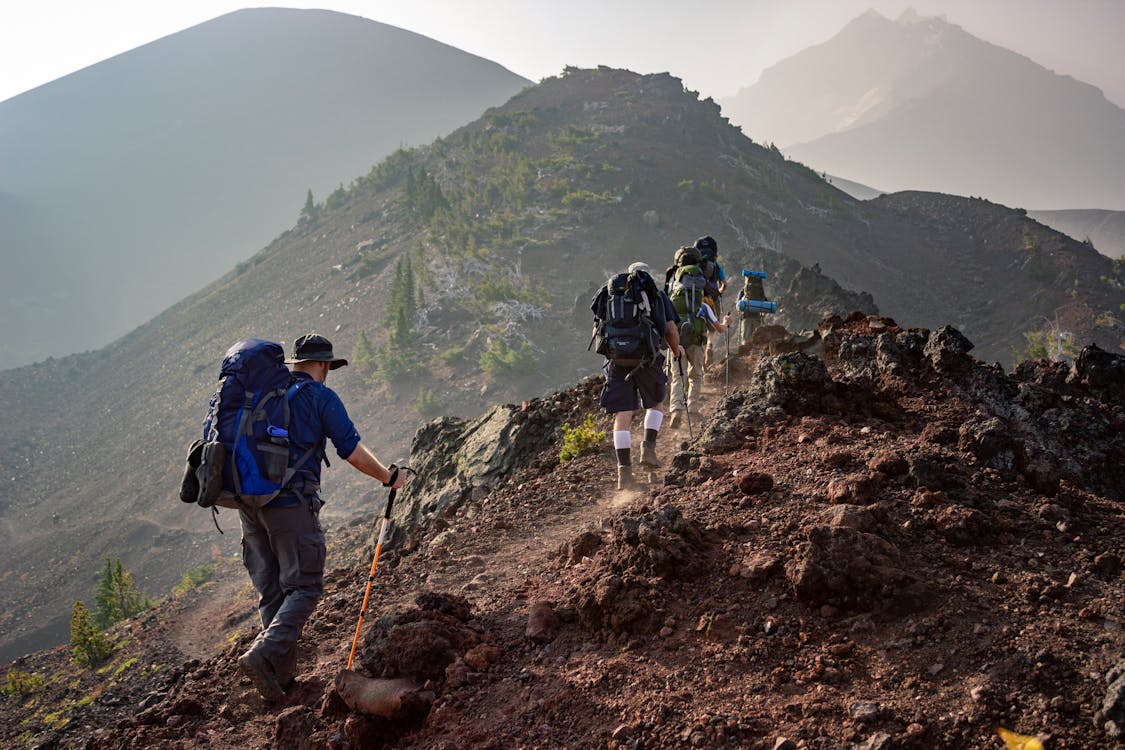
Pick a prominent local hill or ridge, walk to the top as the sun goes down, watch the sunset, sleep, watch the sunrise, descend. This is the microadventure in its most distilled form.
The summit camping experience is qualitatively different from valley camping: the views change with light, the exposure to weather is real, and the isolation from other humans is often total. You don’t need to be on a 3,000m Alpine peak to get this experience — a 400m hill an hour from home does the job.
Safety note: Weather on exposed ridges can change rapidly. Check the forecast carefully, carry warm layers beyond what seems necessary, and have a descent route in mind if conditions deteriorate overnight.
Swimming Wild + Camping
Wild swimming and overnight camping combine naturally — find a lake, river, or coastal spot with both camping possibility and good swimming, spend the evening and morning in the water, sleep between sessions. This format works particularly well in summer and early autumn when water temperatures are comfortable.
The intersection of wild swimming locations and accessible camping spots creates a specific geography worth mapping locally. Once you find good spots, they become reliable resources for repeated microadventures across different seasons.
Our wild swimming guide covers wild swimming locations and safety considerations that complement overnight camping.
Train-Accessible Overnight Adventures
The train-based microadventure is particularly valuable in Europe and parts of Asia where rail networks connect cities to countryside directly. The format:
- Take the last train on Friday evening to a rural station
- Walk from the station into nearby landscape
- Camp overnight
- Walk back to station in the morning
- Return to city in time for a late breakfast
No car required, no driving fatigue, and the train journey itself provides transition time between urban headspace and outdoor presence. In the UK, Dartmoor is accessible by train from London (2.5 hours), the Lake District from Manchester (1 hour), and the Cairngorms from Edinburgh (2.5 hours). In Germany, virtually every major hiking area is rail-accessible.
Sea Kayak Overnight
For those near coastlines, an overnight sea kayak microadventure delivers an experience unavailable to landlocked adventurers. Load a sea kayak with camping gear, paddle along the coast for a few hours, find a beach or headland accessible only by sea, camp, and paddle back.
The sea access element creates genuine wilderness feel even in populated coastal areas — many coves and beaches are entirely inaccessible overland, meaning you’ll often have them to yourself. Safety requirements (VHF radio, appropriate kayak skills, weather awareness) scale up compared to other microadventure formats; a sea kayaking course before attempting overnight trips is strongly recommended.
Planning Your First Microadventure
Identify the Landscape
Start by mapping what’s within 2 hours of your home by any transport — car, bike, train, bus. Hills, forests, rivers, coastline, moors — any of these contain microadventure potential. Tools:
- Ordnance Survey maps (UK) or equivalent national mapping at 1:25,000 scale
- Open Street Map for identifying trails and access routes
- komoot app for route planning and community route knowledge
- Wild Camping Scotland / Dartmoor National Park and equivalent guides for legal wild camping areas
Check the Regulations
Wild camping regulations vary significantly by location. Know before you go:
- Scotland: Right to roam includes wild camping on unenclosed land — largely unrestricted
- Dartmoor National Park (England): Wild camping permitted in designated areas
- Rest of England and Wales: Wild camping technically requires landowner permission; many people camp discreetly with leave-no-trace discipline
- US: Dispersed camping on National Forest and BLM land is generally legal with distance requirements from water and trails; National Parks have specific regulations
- Most of Europe: Regulations vary by country — Scandinavia is very permissive; France and Germany have more restrictions
Leave no trace is the universal expectation: carry out all waste, leave nothing behind, minimize fire impact (carry a stove, avoid open fires in dry conditions).
Equipment for Overnight Microadventures
The beauty of microadventures is that they require minimal equipment. A genuinely functional overnight kit weighs under 5kg:
| Item | Weight | Notes |
|---|---|---|
| Sleeping bag (3-season) | 800-1,100g | Temperature rating to forecast low + 5°C buffer |
| Bivy sack or tarp | 300-500g | Tarp is lighter; bivy is more weatherproof |
| Sleeping mat (inflatable) | 350-500g | Sea-to-Summit Ultralight is excellent |
| Stove + fuel + pot | 300-500g | Optional for overnight; cold food simplifies |
| Water filter | 90g | Sawyer Squeeze |
| Headlamp | 90g | Spare batteries essential |
| First aid basics | 150g | Blister care, pain relief, wound care |
| Navigation | 100g | Map, compass; phone backup |
The total kit can fit in a 25-30L daypack for overnight trips. No expedition pack required.
For more advanced gear selection for multi-day adventures, our ultralight backpacking gear guide covers comprehensive ultralight systems.
Building a Microadventure Habit
The transformative power of microadventures comes from frequency rather than individual event magnitude. Monthly overnight trips reset perspective more thoroughly than a single annual expedition.
Monthly calendar blocking — treat microadventure nights like appointments. A Thursday-night overnight every 4-6 weeks becomes a rhythm that sustains through busy work periods.
Weather tolerance — the best microadventures are often in imperfect weather. A night in a bivy during light rain develops weather tolerance and creates more memorable experiences than perfect summer nights.
Rotation of formats — alternating between walking, cycling, swimming, and kayaking overnight trips prevents repetition and develops broader outdoor skills.
Progressive challenge — start with accessible, comfortable conditions and add challenge incrementally: winter cold, technical terrain, navigation challenges, longer distances.
Sharing and Community
The microadventure movement has a strong social component. Sharing trip reports — photos, routes, lessons learned — builds the community knowledge base and often provides the social accountability that makes consistent practice more likely.
Instagram’s outdoor community documents microadventures extensively under #microadventure; Alastair Humphreys’ own website (alastairhumphreys.com) remains the philosophical center of the movement. Local hiking clubs and outdoor communities increasingly incorporate microadventure events into their social calendars.
For broader adventure planning including multi-day trips that extend beyond the microadventure format, our hiking trails bucket list covers routes globally that make natural progressions from local overnight starting points.
Related Reading
- Off-Grid Wilderness Camping: Complete Guide
- Bikepacking Routes: Ultimate Beginner’s Guide
- Wild Swimming Guide: Best Spots 2026
Microadventures are the best argument against waiting for the perfect trip. The hills outside your city are there now. The river at the end of the train line has been there the whole time. The beach accessible only by kayak has been empty every weekend you’ve spent indoors. The microadventure is not a substitute for bigger adventures — it’s the practice that makes bigger adventures more meaningful, and the habit that ensures you’re always adventuring. Start this week. The only equipment you absolutely need is a sleeping bag — our best sleeping bags for backpacking roundup covers sub-1kg options that work equally well for a backyard bivvy and a week-long backcountry trip — a willingness to be slightly uncomfortable, and the decision to actually go.
Get the best ThrillStays tips in your inbox
Weekly guides, deals, and insider tips. No spam, unsubscribe anytime.