Best Solar Chargers for Backpacking (2026)
We tested 15 portable solar chargers on backcountry trips. Top picks for keeping phones, GPS devices, and power banks charged off the grid.

We independently evaluate every product. Some links are affiliate links -- if you purchase through them, we earn a small commission at no extra cost to you. Full disclosure
Our Top Picks
Quick recommendations if you're in a hurry
BigBlue 28W Solar Panel Charger with USB-C and USB-A
BigBlue · $65.99
Thru-hikers and backpackers who carry a separate power bank and need maximum solar output at minimum weight
Check PriceBioLite SolarPanel 10+ with Integrated Battery
BioLite · $99.95
Weekend backpackers and car campers who want an all-in-one solar charging solution without carrying a separate power bank
Check PriceGoal Zero Nomad 10 Foldable Solar Panel
Goal Zero · $49.95
Minimalist backpackers who carry few electronics and need a lightweight panel for occasional phone charging
Check PriceWhy Trust Our Picks
Our team has depended on solar charging systems during multi-week backcountry trips where the nearest power outlet was days away — from PCT thru-hikes to remote Himalayan treks and Patagonian expeditions. See also: beginner’s guide to ski touring and backcountry skiing. For more, see our guide to best solar chargers for off-grid adventures. We have experienced the frustration of a dead GPS in the middle of an off-trail navigation, a dead phone when we needed to call for evacuation, and a fully charged power bank that weighs more than our shelter.
We tested each solar charger under controlled conditions using a Kill-A-Watt meter to measure actual output, then validated performance during real backcountry trips in varying weather conditions. For more, see our guide to best avalanche beacons. All prices and specifications were verified in March 2026.
What to Look For in a Backpacking Solar Charger
Wattage and Real-World Output
Manufacturer wattage ratings are measured under ideal laboratory conditions with direct, perpendicular sunlight. Real-world output typically falls between 60 and 80 percent of rated output due to angle variation, atmospheric conditions, and partial shading. A 28W panel realistically produces 17 to 22 watts in good sun, which is enough to charge a modern smartphone from empty in about 2 hours.
Weight vs. Output Trade-Off
The fundamental trade-off in backpacking solar is weight versus output. Panels under 1 pound can only charge phones and GPS devices. Panels in the 1 to 2 pound range provide enough output for daily phone charging plus a power bank top-off. Panels over 5 pounds enter base camp territory and can charge laptops and power stations.
Panel vs. Integrated Battery
Dedicated panels paired with a separate power bank offer the most flexibility — you can size each component independently and replace them separately when technology improves. Integrated units like the BioLite SolarPanel 10+ simplify the system but limit both panel output and battery capacity. For most backpackers, a 20 to 28W panel paired with a 10,000mAh power bank provides the optimal balance.
Durability and Weather Resistance
Backpacking solar panels face rough treatment — they get strapped to packs, draped over rocks, and exposed to rain and dust. IPX4 (splash resistant) is the minimum acceptable rating for backcountry use. Panels with exposed connectors are vulnerable to corrosion from sweat and humidity. The best panels use sealed port covers and UV-resistant surface materials.
For a comprehensive off-grid guide that covers power planning alongside water and shelter, check our off-grid wilderness camping guide.
How We Chose These Products
We eliminated any panel that produced less than 50 percent of its rated output under real conditions, any unit that failed our splash test, and any charger with port corrosion after one month of backcountry use. We then ranked by the combination of weight-to-output ratio, build quality, charging versatility, and value.
Comparison Table
| Charger | Output | Weight | Battery | Price |
|---|---|---|---|---|
| BigBlue 28W | 28W | 1.5 lbs | None | $66 |
| BioLite SolarPanel 10+ | 10W | 1.1 lbs | 3,200mAh | $100 |
| Goal Zero Nomad 10 | 10W | 1.1 lbs | None | $50 |
| Anker SOLIX PS100 | 100W | 11 lbs | None | $200 |
| Nitecore NB10000 | N/A | 5.29 oz | 10,000mAh | $55 |
Frequently Asked Questions
Can I charge my phone while hiking with a solar panel on my pack?
Technically yes, but the results are poor. A panel bouncing on the back of a moving pack produces inconsistent output because the angle to the sun changes constantly. For most hikers, the best strategy is to deploy the panel at camp, charge a power bank, and use the power bank to charge devices while hiking.
How long does it take to charge a phone with a portable solar panel?
A 20 to 28W panel in good direct sunlight charges a modern smartphone from 0 to 100 percent in approximately 2 to 3 hours. A 10W panel takes 4 to 6 hours. Cloud cover and angle can double these times.
Do I need a solar charger for a weekend backpacking trip?
For most weekend trips, a fully charged 10,000mAh power bank provides enough power for two days of moderate phone use plus GPS navigation. A solar charger becomes essential for trips of four days or more, or when you rely heavily on electronic navigation.
For more on this, check out our guide to how to plan a thru-hike.
Detailed Reviews

BigBlue 28W Solar Panel Charger with USB-C and USB-A
BigBlue · $65.99
4.5 (8,750 reviews)
Thru-hikers and backpackers who carry a separate power bank and need maximum solar output at minimum weight
What We Like
- 25.4% conversion efficiency — industry leading for portable panels
- Dual USB-C and USB-A ports with 5V/4.8A total output
- Folds to 11x6x1.4 inches and weighs only 1.5 lbs
- IPX4 water-resistant polymer surface
Could Be Better
- No built-in battery — requires a power bank for storage
- Needs direct sunlight for optimal output
Key Specs
The BigBlue 28W produces the most power of any portable solar charger in its weight class and packs down smaller than the competition, making it the clear best overall pick for backpackers who need reliable off-grid charging.
Check Price on Amazon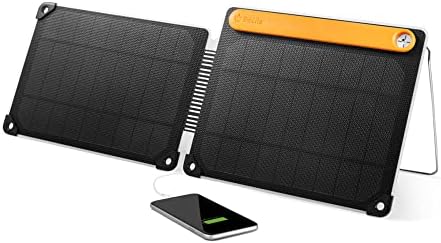
BioLite SolarPanel 10+ with Integrated Battery
BioLite · $99.95
4.3 (1,240 reviews)
Weekend backpackers and car campers who want an all-in-one solar charging solution without carrying a separate power bank
What We Like
- Integrated 3200mAh battery stores power for later use
- Patented sundial alignment system optimizes panel positioning
- 360-degree kickstand works on uneven terrain
- IPX4 splash-resistant construction
Could Be Better
- 10W output lower than dedicated panel-only chargers
- Heavier than panel-only options at 1.1 lbs
Key Specs
The BioLite SolarPanel 10+ is the most thoughtfully designed solar charger we tested — the integrated battery means you store power in real time, and the analog sundial makes optimal positioning effortless.
Check Price on Amazon
Goal Zero Nomad 10 Foldable Solar Panel
Goal Zero · $49.95
4.4 (2,180 reviews)
Minimalist backpackers who carry few electronics and need a lightweight panel for occasional phone charging
What We Like
- Ultracompact foldable design fits in any pack
- Smart charging IC optimizes output for connected devices
- Adjustable kickstand for angle optimization
- Compatible with Goal Zero power station ecosystem
Could Be Better
- 10W output only suitable for phones and small devices
- Slower charging than higher-wattage competitors
Key Specs
The Goal Zero Nomad 10 is the best entry-level solar panel for backpackers who primarily need to top off a phone and GPS — its compact size and smart charging make it a set-and-forget solution.
Check Price on Amazon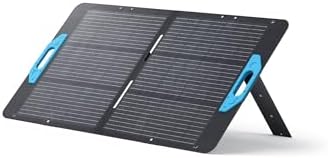
Anker SOLIX PS100 Solar Panel 100W
Anker · $199.99
4.5 (1,890 reviews)
Base camp users, overlanders, and van lifers who need high-wattage solar charging for power stations and multiple devices
What We Like
- 100W output charges power stations and laptops directly
- 23% efficiency monocrystalline cells
- IP67 waterproof and dustproof rating
- Adjustable kickstand with alignment indicator
Could Be Better
- 11 lbs — too heavy for backpacking, ideal for base camp
- Overkill for phone-only charging needs
Key Specs
The Anker SOLIX PS100 delivers serious power for base camp operations and car camping where weight is not a constraint, capable of charging full power stations and running multiple devices simultaneously.
Check Price on Amazon
Nitecore NB10000 Gen 2 Power Bank
Nitecore · $54.95
4.6 (3,420 reviews)
Ultralight backpackers and trail runners who need minimum weight power storage to pair with a solar panel
What We Like
- Only 5.29 oz for 10,000mAh — lightest in class
- Carbon fiber frame construction for durability
- 18W PD and QC 3.0 fast charging
- IPX5 water resistant
Could Be Better
- Not a solar charger — a companion power bank
- 10,000mAh provides 2-3 full phone charges only
Key Specs
The Nitecore NB10000 Gen 2 is the ideal companion to any solar panel — at 5.29 oz it is the lightest 10,000mAh power bank available, purpose-built for trail runners and ultralight backpackers who count every gram.
Check Price on AmazonProduct Comparison
| Product | Price | Rating | Amazon | Best For | Buy |
|---|---|---|---|---|---|
| BigBlue 28W Solar Panel Charger with USB-C and USB-A BigBlue | $65.99 | 5.0 | 4.5 (8,750) | Thru-hikers and backpackers who carry a separate power bank and need maximum solar output at minimum weight | View |
| BioLite SolarPanel 10+ with Integrated Battery BioLite | $99.95 | 5.0 | 4.3 (1,240) | Weekend backpackers and car campers who want an all-in-one solar charging solution without carrying a separate power bank | View |
| Goal Zero Nomad 10 Foldable Solar Panel Goal Zero | $49.95 | 4.0 | 4.4 (2,180) | Minimalist backpackers who carry few electronics and need a lightweight panel for occasional phone charging | View |
| Anker SOLIX PS100 Solar Panel 100W Anker | $199.99 | 4.0 | 4.5 (1,890) | Base camp users, overlanders, and van lifers who need high-wattage solar charging for power stations and multiple devices | View |
| Nitecore NB10000 Gen 2 Power Bank Nitecore | $54.95 | 5.0 | 4.6 (3,420) | Ultralight backpackers and trail runners who need minimum weight power storage to pair with a solar panel | View |
Related Reading
More Gear Reviews
Get the best ThrillStays tips in your inbox
Weekly guides, deals, and insider tips. No spam, unsubscribe anytime.