Land Sailing and Land Boarding: Complete Adventure Guide 2026
Discover land sailing and land boarding in 2026. Best destinations, gear guide, techniques, and where to ride wind-powered vehicles on sand and salt flats.
This post may contain affiliate links. Disclosure
Updated for 2026 — Accurate as of February 2026.
The first time I strapped into a land yacht on the vast salt flats of Ivanpah Dry Lake in Nevada, I expected a pleasant breeze-powered trundle across the desert. What I got was 100 kilometers per hour of terrifying, exhilarating, ground-level speed that pinned my cheeks to my skull and had me white-knuckling the steering lines within 30 seconds. Land sailing is one of the most misunderstood adventure sports on the planet. People hear “sailing on land” and picture something gentle and whimsical. In reality, it is one of the fastest non-motorized activities a human can do, with world records exceeding 200 km/h.
Land sailing and its sibling sport land boarding (think kiteboarding but on dirt and sand instead of water) occupy a fascinating niche in the adventure world. They require wind and flat open terrain, which limits them to specific locations. But those locations, desert playas, salt flats, and wide beaches, are among the most dramatic landscapes on Earth. And the feeling of harnessing the wind to move at highway speeds across a flat, featureless expanse, with nothing between you and the horizon but your sail, is a sensation that no other sport replicates.
If you are new to wind sports entirely, our kitesurfing budget guide covers the fundamentals of kite control that transfer directly to land boarding. Before your first session, also read our adventure travel gear guide for what to pack when visiting remote desert and coastal venues.
Land Sailing: What It Is
Land sailing uses a wheeled vehicle (a “land yacht” or “sand yacht”) powered by a sail to travel across flat surfaces. The vehicle typically has three wheels, a low-slung chassis, and a mast-mounted sail that the pilot controls from a reclined or seated position.
Types of Land Sailing Vehicles
| Vehicle Type | Speed Range | Skill Level | Cost (New) | Best Terrain |
|---|---|---|---|---|
| Class 3 Land Yacht | 60-130 km/h | Intermediate-Advanced | $2,000-$8,000 | Salt flats, dry lakes |
| Class 5 Mini Yacht | 40-100 km/h | Beginner-Intermediate | $1,000-$3,000 | Beaches, desert |
| Blokart | 30-80 km/h | Beginner-Intermediate | $2,500-$4,000 | Beaches, parking lots |
| Kite Buggy | 40-120 km/h | Intermediate-Advanced | $500-$2,000 (buggy only) | Beaches, desert |
| Land Board (kite-powered) | 30-80 km/h | Intermediate-Advanced | $200-$600 (board only) | Beaches, desert |
Blokarts deserve special mention as the entry point to land sailing. These compact, cartable land yachts fold down to fit in a car trunk, assemble in five minutes, and can be sailed on any flat surface from beaches to parking lots. The learning curve is 20 to 30 minutes for basic control, which makes them the most accessible wind-powered land vehicle available. Blokart sailing clubs exist in 30+ countries, and many offer rental equipment and lessons.
Accessibility Note: Land sailing is genuinely inclusive — participants as young as 12 and as old as 88 regularly take to the sand. The seated, low-gravity-center design of land yachts makes them stable and non-intimidating for first-timers.
How Land Sailing Works
Land sailing follows the same physics as water sailing, but on a low-friction surface. The sail captures wind energy and converts it into forward motion through the vehicle’s wheels. Because wheel friction is much lower than water resistance, land yachts can travel significantly faster than the wind speed, often 3 to 5 times wind speed on a perpendicular course.
Key differences from water sailing:
- Speed: Land yachts are faster than sailboats in equivalent wind conditions
- Feedback: Steering inputs produce immediate, dramatic responses
- Capsizing: Yes, land yachts can and do capsize. At speed, this is dangerous.
- Tacking and jibing: Same principles as water sailing, but executed at much higher speeds
- Right of way: Sailing rules apply, but enforcement is informal on open terrain
Land Boarding: The Standing Alternative
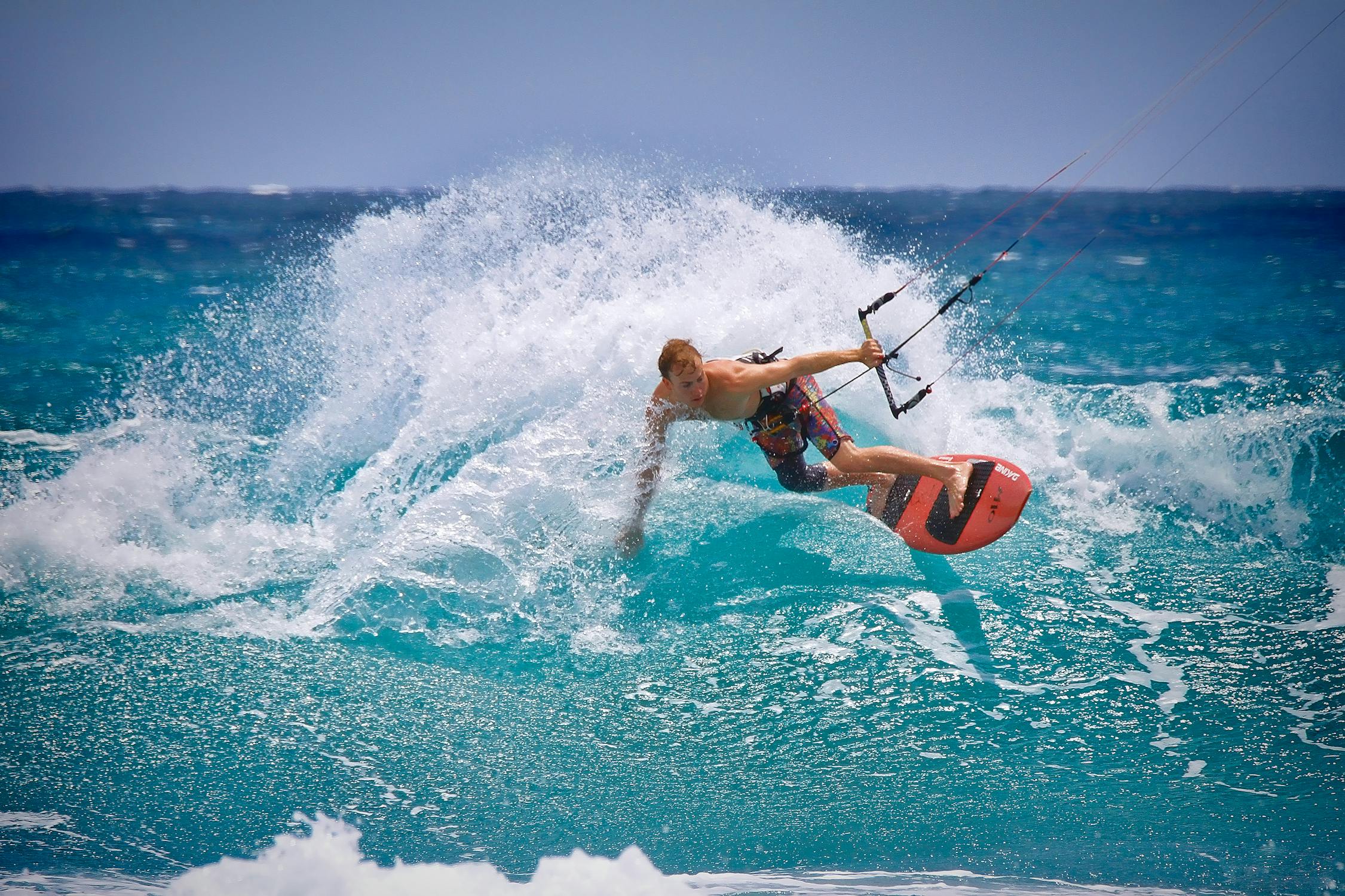
Land boarding uses a large skateboard-like board (typically 90 to 120 cm long with pneumatic tires) powered by a kite. The rider stands on the board and controls the kite with a bar, generating speed and performing jumps.
How it relates to kiteboarding: Land boarding is essentially kiteboarding on land. The kite skills transfer directly between the two sports. Many kiteboarders practice land boarding during low-wind or no-water periods. The board skills, however, are different: you are on a hard surface with no water to cushion falls.
Equipment needed:
- Mountain board: A wide, stable board with pneumatic tires and foot straps. The MBS Colt 90X Mountainboard is the go-to entry-level board, arriving fully assembled with a brake system. Cost: $200 to $600.
- Kite: A power kite suitable for land use. Trainer kites (2 to 4 square meters) for learning, full power kites (6 to 12 square meters) for experienced riders. Cost: $200 to $1,500.
- Harness: A seat or waist harness that connects you to the kite, distributing pull forces across your body. Cost: $80 to $200.
- Safety gear: Helmet (mandatory — the Consumer Product Safety Commission recommends certified helmets for all wheeled sports), knee pads, elbow pads, gloves, and a spine protector for aggressive riding. The Triple Eight Gotham MIPS Helmet is dual-certified for both bike and skate impacts. Cost: $100 to $300.
Best Destinations for Land Sailing and Land Boarding
1. Black Rock Desert, Nevada, USA
The Black Rock Desert playa is a 400-square-mile flat, hard surface that is the world’s premier land sailing venue. The surface is so flat and vast that you can sail for 30+ kilometers in a straight line without encountering an obstacle. Wind conditions are reliable from April through October, with afternoon thermal winds of 20 to 35 km/h being common.
Why it is special: The sheer scale of the playa is unmatched anywhere. The Bureau of Land Management manages the area for recreational use. The surface is hard-packed alkaline clay that provides minimal rolling resistance. The record for the fastest wind-powered land vehicle (222.4 km/h, set in 2009 by the Greenbird) was set at Ivanpah Dry Lake nearby.
Practical tips: No permits required for recreational land sailing. Carry all water and supplies; there are no services on the playa. The surface is extremely dusty when dry. Wear goggles and protect electronics. The nearest town, Gerlach, is a 30-minute drive from popular sailing areas.
Best season: April through October
2. St. Andrews Beach, Scotland
St. Andrews’ West Sands beach is a 2-mile stretch of firm, flat sand that has hosted land yacht racing since the 1950s. The consistent coastal winds and wide beach make it an ideal venue for beginners and experienced sailors alike. Blow Karting Scotland operates rental equipment and lessons on the beach from April through October.
Why it is special: Accessible, affordable, and with reliable wind. Lessons start at $40 per hour, and the setting (with the medieval town of St. Andrews as a backdrop) is stunning.
Best season: April through October
3. Bonneville Salt Flats, Utah, USA
The Bonneville Salt Flats are famous for land speed records, and the hard, flat surface is equally suitable for land sailing. The flats are accessible year-round, though the surface condition varies with rainfall. Late summer and fall typically offer the best surface conditions and most reliable winds.
Best season: July through October
4. Romo Beach, Denmark
Romo (Romø) Island in southern Denmark has one of the widest beaches in Europe, over 4 kilometers wide at low tide. The firm sand and consistent North Sea winds make it one of Europe’s best land sailing and kite bugging destinations. International land sailing competitions are held here regularly.
Best season: March through October
5. Le Touquet and Berck, France
The northern French coast has a long tradition of char a voile (sand sailing). The wide, flat beaches between Le Touquet and Berck offer 30+ kilometers of continuous sailing terrain at low tide. Multiple operators offer lessons and rentals from $30 to $60 per hour. Normandy’s beaches (including the historic D-Day landing beaches) also offer land sailing — combining history with wind sport.
Best season: March through October
6. Ivanpah Dry Lake, California, USA
Located south of Las Vegas near the California-Nevada border, Ivanpah is smaller than Black Rock but closer to a major airport and offers equally hard, flat surface. The Las Vegas land sailing community regularly uses this venue and the site is accessible year-round with consistent thermal afternoon winds.
Best season: Year-round (summer is hottest; spring and fall are ideal)
7. Pampa del Leoncito, Argentina
El Leoncito National Park in northwest Argentina offers a stunning high-altitude playa (the Pampa del Leoncito) with reliable winds and mountain scenery surrounding the flat expanse. It is one of the southern hemisphere’s most dramatic land sailing venues and far less known than the North American sites.
Best season: March through November (Argentine autumn and spring)
8. Skeleton Coast, Namibia
The Skeleton Coast’s vast desert beaches and consistent offshore winds create otherworldly land sailing conditions. Few formal operators exist, but for experienced land sailors willing to bring their own equipment, the empty beaches stretching for hundreds of kilometers are an ultimate frontier.
Best season: Year-round
Destination Comparison
| Destination | Wind Reliability | Surface Quality | Accessibility | Cost | Season |
|---|---|---|---|---|---|
| Black Rock Desert, NV | Good (thermal) | Excellent | Moderate (remote) | Low | Apr-Oct |
| St. Andrews, Scotland | Good (coastal) | Good (sand) | Excellent | Moderate | Apr-Oct |
| Bonneville Salt Flats, UT | Moderate | Very Good | Good | Low | Jul-Oct |
| Romo, Denmark | Very Good (coastal) | Very Good (sand) | Good | Moderate | Mar-Oct |
| Le Touquet, France | Good (coastal) | Good (sand) | Excellent | Moderate | Mar-Oct |
| Ivanpah Dry Lake, CA | Good (thermal) | Excellent | Good | Low | Year-round |
| Pampa del Leoncito, Argentina | Very Good | Excellent | Moderate | Low | Mar-Nov |
| Skeleton Coast, Namibia | Excellent | Good (sand) | Poor (remote) | High | Year-round |
 Photo credit on Pexels
Getting Started: A Beginner’s Guide
Learning Land Sailing
Day 1: Most schools start with ground-based kite handling (for kite buggying/land boarding) or static vehicle familiarization (for land yachts). You learn how the sail generates power, how to steer, and how to stop. By the end of day one, most people are sailing independently in light wind.
Week 1: You develop comfort with speed, learn to tack and jibe, and begin to understand wind angles intuitively. Land sailing has a faster learning curve than water sailing because the immediate feedback (you either move or you do not) accelerates understanding.
Month 1: You are sailing in moderate wind (20-30 km/h) with confidence, able to navigate around obstacles and other sailors, and beginning to experiment with speed optimization.
Safety Essentials
Land sailing is not inherently dangerous, but the speeds involved demand respect:
- Helmet: Mandatory. A full-face karting or motorcycle helmet for high-speed sailing, a bicycle or skateboard helmet for lower speeds.
- Goggles: Sand and dust at speed are painful and can cause eye damage. Sealed goggles or a full-face helmet solve this.
- Gloves: Rope and sheet handling can burn bare hands.
- Footwear: Closed-toe shoes with ankle support. Bare feet and sandals are dangerous around moving vehicles.
- Weight: Land yachts handle differently depending on pilot weight. Heavier pilots have more stability but less speed; lighter pilots accelerate faster but are more prone to capsizing.
- Other traffic: On beaches, be aware of pedestrians, dogs, horses, and other vehicles. On salt flats, visibility can be deceptive due to the flat, featureless terrain.
Cost to Get Started
Rental/lesson route (recommended for beginners):
- One-hour lesson with rental equipment: $40 to $80
- Full day with equipment: $100 to $200
- Weekend course: $200 to $400
Ownership route:
- Blokart (best entry-level): $2,500 to $4,000 new
- Used kite buggy + kite: $500 to $1,500
- Mountain board + trainer kite: $300 to $600
- Full land yacht (Class 5): $1,000 to $3,000 used
Land Sailing vs Land Boarding Comparison
| Factor | Land Sailing (Yacht) | Land Boarding (Kite) |
|---|---|---|
| Learning curve | Faster (seated, stable) | Slower (standing, balance required) |
| Top speed | Higher (100+ km/h possible) | Lower (typically 30-80 km/h) |
| Portability | Moderate (trailer or large car) | Excellent (fits in a bag) |
| Cost entry | Higher ($1,000+) | Lower ($400+) |
| Physical demand | Low-Moderate | Moderate-High |
| Jump potential | None | Excellent (15m+ jumps possible) |
| Terrain flexibility | Needs very flat surface | Works on moderate terrain |
| Risk level | Moderate (capsizing) | Higher (falls, kite control) |
Building a Land Sailing Community
Land sailing is inherently social. Unlike surfing or climbing, where you can practice solo, land sailing benefits from shared terrain, safety in numbers, and the camaraderie of comparing speeds and techniques. Here is how to connect:
National federations: Most countries with active land sailing have national federations that organize races, maintain safety standards, and connect riders. The North American Land Sailing Association (NALSA), the British Federation of Sand and Land Yacht Clubs (BFSLYC), and the French Federation de Char a Voile are the major organizations.
Blokart clubs: The Blokart community is the most accessible entry point. Clubs exist in 30+ countries and most welcome newcomers with rental equipment and instruction. A Google search for “Blokart club [your region]” will find the nearest group.
Online communities: Reddit’s r/landsailing, Facebook groups, and the Blokart Forum are active communities where riders share videos, locations, and technical advice. The wind sport crossover means that kiteboarding and windsurfing communities often include land sailors.
Events and competitions: Land sailing regattas range from informal club races to the European and World Championships. The competitive scene is friendly and inclusive, with separate classes for different vehicle types and skill levels. Attending a regatta, even as a spectator, is the fastest way to learn about the sport and meet experienced sailors.
Related Reading
Get the best ThrillStays tips in your inbox
Weekly guides, deals, and insider tips. No spam, unsubscribe anytime.