Jordan and Wadi Rum Car Rental Guide 2026: What to Know
Rent and drive in Jordan the right way: driver age rules, real price bands from six operators, insurance gaps, and the roads into Wadi Rum's desert tracks.

This post may contain affiliate links. Disclosure
A rental car is the only way to see Jordan on your own clock - sunrise at Petra’s Treasury before the tour buses arrive, a detour to the Roman ruins at Jerash, then a straight run south to the red sand of Wadi Rum. The country’s highways are modern and well-marked, but the desert tracks past the pavement are a different game entirely. This guide covers exactly what you need to rent with confidence: who to book with, what it actually costs, what insurance covers (and what it doesn’t), and how to handle the switch from asphalt to sand without getting stuck or stung by a surprise fee.
Short answer: Most Jordanian companies rent from age 21, with premium SUV operators pushing that to 23 or 25, and require a licence held at least a year plus an International Driving Permit if it is not printed in English or Arabic. Economy cars run $42-54 a day, midsize about $77, and 4x4 SUVs around $109.
Driver Requirements and Documentation

The baseline requirements across Jordan’s rental market are consistent enough that you can plan around them before you land. Most companies set the minimum driver age at 21, though a handful of operators - especially the ones running premium SUVs - push that floor to 23 or 25. You need a valid driver’s license from your country of residence, held for at least one year. If that license isn’t printed in English or Arabic, bring an International Driving Permit; agents at the counter will ask for it, and you don’t want to be sorting that out after a long flight.
Your passport is the primary form of ID at pickup, and a credit card in the renter’s name is mandatory for the security deposit - a debit card generally will not work, according to Expat Focus’s Jordan rental guide. If you’re under 25, budget for a daily young-driver surcharge; it’s standard across the market, not a red flag specific to any one company.
Six local operators cover most of the country: Dunya Car Rental, Wadi Rum Oasis, CarsRenter, Retaj Car Rental, Rushmore Car Rental, and Golden Drive. Dunya runs pickup desks at Queen Alia International Airport, Aqaba Airport, and city offices in Amman, Petra, the Dead Sea, and Wadi Rum itself, which makes it one of the easier options if you’re landing and driving straight out. Wadi Rum Oasis has been running car rental and desert tour services out of Amman since 2014, and pairs its fleet with guided desert tours if you’d rather not navigate the sand tracks solo on your first trip. Retaj has been in business since 1996 and operates a 70-vehicle licensed fleet across the country - a track record worth noting if you’d rather book with an operator that’s been through a few decades of Jordanian road conditions already. Rushmore Car Rental and Golden Drive round out the local field, both offering the same flexible pickup and drop-off model as the larger operators. If you’d rather stick with a name you already know, Avis, Budget, National, and Thrifty all run counters at Queen Alia International Airport as well, though the local operators generally beat them on price for the same vehicle class.
The credit card deposit is worth planning around before you arrive. Because Expat Focus specifically flags this as mandatory - not optional, and not satisfied by a debit card - make sure the card is in the driver’s own name and carried to the counter, not left with a travel companion. A rental booked online but collected by someone whose name isn’t on the reservation is a common way trips get delayed at pickup.
Choosing the Right Vehicle: Price Bands and What Fits Where

Jordan’s rental market splits cleanly into three price tiers, and knowing which one you actually need before you book will save you money.
| Class | Typical Daily Rate (USD) | Best For |
|---|---|---|
| Economy (compact) | $42-$54 | Amman streets, short highway runs |
| Standard / midsize | ~$77 | Longer inter-city drives, families |
| Premium / SUV (4x4) | $109.35 | Wadi Rum desert tracks, gear hauling |
Kayak’s aggregated listings put economy compacts as low as $42 a day, with standard midsize cars averaging around $77. On the premium end, Dunya Car Rental quotes $109.35 a day for a 4-seat SUV - the number to plan around if a desert run is on your itinerary.
That premium tier isn’t padding. If Wadi Rum is part of your route, a 4x4 SUV is the right call, not an upsell. CarsRenter specifically advertises a fleet built for desert travel, and Wadi Rum Oasis bundles 4x4 rentals with its own tour packages if you’d rather have local knowledge along for the sand sections. For everything else - Amman’s city grid, the waterfront drive in Aqaba, the short hop out to Jerash - a compact or midsize sedan handles it fine and keeps your fuel and rental costs down. Don’t pay for ground clearance you’re not going to use, and don’t try to save money on the one stretch where you actually need it.
Insurance Basics: What’s Covered and What You May Need Extra

Most Jordanian rental quotes already bundle a Collision Damage Waiver and theft protection into the daily rate - Dunya’s pricing, for example, includes this basic coverage by default. In practice, that means you’re not on the hook for accidental vehicle damage or theft as long as you stay within the terms of the contract. It’s a reasonable baseline, but it’s not comprehensive, and most companies offer paid upgrades worth knowing about before you’re standing at the counter:
- Super-CDW - lowers or eliminates the excess (deductible) you’d otherwise owe out of pocket after an incident.
- Personal Accident Insurance - covers medical costs for you and your passengers.
- Supplemental Third-Party Liability - raises your liability limits above the statutory minimum.
If your plan includes any real off-road driving in Wadi Rum, the Super-CDW is worth the extra few dollars a day. Sand and rock scrapes are common on desert tracks, and the basic CDW excess can be a few hundred dollars you’d rather not pay for a scuff. Whatever level of coverage you choose, get a printed insurance certificate before you leave the lot - you’ll need it at border checkpoints like the King Hussein Bridge, and any police stop will ask for it alongside your rental agreement.
Jordan’s Roads: From Amman to the Desert
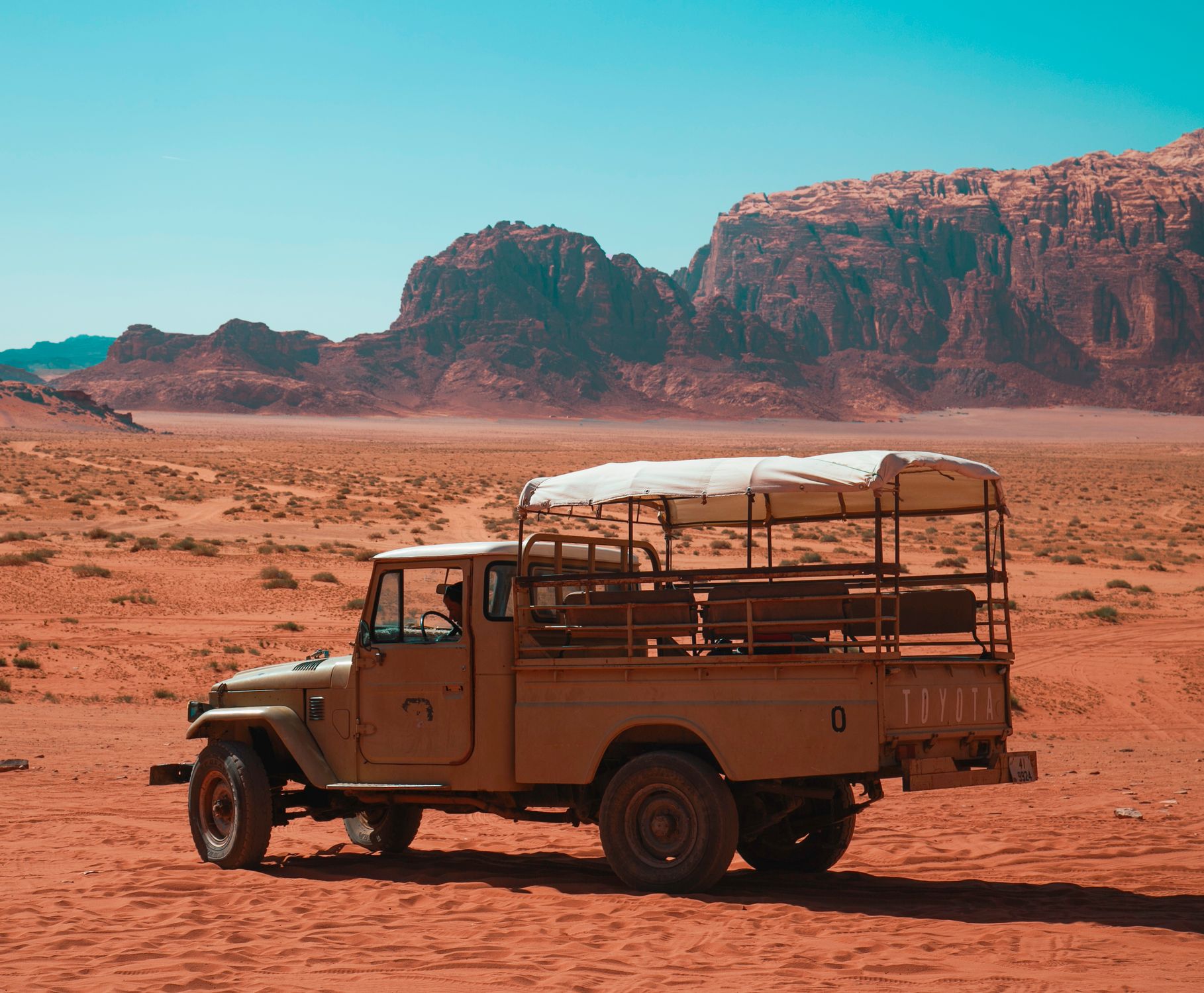
The King’s Highway, Highway 35, is the spine of the country - a fully paved, clearly signed north-south route linking Amman, Madaba, and Petra. Most of the network is toll-free; the main fee you’ll run into is a bridge crossing charge at the King Hussein Bridge, managed directly by the Ministry of Transport.
The pavement ends once you turn off toward Wadi Rum. From there it’s gravel and sand, and that’s where the extra clearance and torque of a 4x4 stop being nice-to-haves and start being the thing that keeps you from digging your tires into soft sand a mile from the nearest track. Fuel stations line the main highways at regular intervals but thin out fast once you’re off them - top off before you leave the paved road, not after you notice the gauge dropping. Parking is its own small logistics puzzle in the cities: street parking in Amman and Aqaba is limited and often metered or resident-restricted, though most hotels and desert camps run their own private lots.
The Ministry of Transport’s published road-safety statistics show a low rate of major accidents on the primary highways. The risk climbs on narrow mountain passes and in sand-covered stretches near Wadi Rum, where visibility can drop with almost no warning - drive those sections slower than you think you need to.
Remember, too, that the highway is only the first leg. The paved network is what gets you to the trailheads and canyon entrances - the actual jumping-off points for Wadi Rum’s canyoneering routes and the backcountry approaches to Petra sit off the main road, down unmarked gravel spurs. A 4x4 doesn’t just get you through the desert, it gets you to the start of the hike, which is the part a two-wheel-drive sedan will leave you walking to.
Staying Safe on Jordan’s Roads
Road conditions are only half the safety picture - it’s worth knowing where the country sits on the broader travel-risk scale before you go.
Safety: The U.S. State Department rates Jordan Level 3 - Reconsider Travel. The UK Foreign Office advises staying aware of your surroundings and avoiding crowds, and notes that while crime levels are generally low, there is a risk of pickpocketing, bag-snatching and theft from cars (US advisory - UK FCDO, updated 2026-06-26).
For drivers specifically, the practical takeaway is straightforward: don’t leave valuables visible in a parked car, keep doors locked while driving through crowded areas in Amman and Aqaba, and don’t leave the rental unattended with gear inside at trailheads or desert pull-offs. None of this should keep you off the road - Jordan’s highway network is genuinely easy to navigate - but it’s worth building into your routine the same way you’d plan fuel stops or insurance coverage.
Practical Tips for Renting and Driving in Wadi Rum
A short list of the details that actually save you time and money on the ground:
- Book early, especially 4x4s. Demand spikes in spring and autumn, and securing a desert-ready vehicle weeks ahead locks in both availability and the lowest price.
- Use pickup flexibility to your advantage. Retaj Car Rental and Rushmore Car Rental, among others, allow airport pickup and drop-off in major towns - match the location to your flight schedule instead of building in an extra transfer.
- Check the mileage clause. Standard contracts typically include unlimited kilometers, but some premium packages cap it. Confirm this before you sign, not after you’re billed for overage.
- Carry a printed rental agreement. Border officials at the King Hussein Bridge routinely ask for a hard copy of both the agreement and the insurance certificate. Keep a photo on your phone as a backup, but paper is what gets checked.
- Plan your fuel stops around Ma’an. The last major station before the desert approach sits near the town of Ma’an; after that, your next reliable refill is typically at a campsite or back at the Aqaba airport. Keep the tank above half before you turn onto gravel.
- Adjust to local driving norms. Jordanians drive on the right. Expect slower city traffic and the occasional livestock crossing on rural roads, and go easy on the horn in residential areas - it reads as rude, not helpful.
- Pack a basic emergency kit. A spare tire, jack, water, and a first-aid kit are cheap insurance for anyone heading past the paved highway, regardless of what your rental contract covers.
Common Mistakes to Avoid
- Skipping the 4x4 for desert sections. A midsize sedan is fine on Amman’s streets, but sand demands higher clearance and four-wheel drive. The price difference is small next to the cost of a tow.
- Ignoring the under-25 surcharge. It’s a standard industry clause, not a hidden fee, but it adds up fast if you haven’t priced it into your budget.
- Assuming the basic CDW covers everything. It doesn’t - the standard excess can be sizable. Upgrade to Super-CDW if any part of your route touches Wadi Rum’s off-road tracks.
- Running the tank low in the desert. Fuel stations thin out well before you reach Wadi Rum. Top up at the last town, not when the gauge tells you to.
- Leaving the rental agreement at the hotel. Border checkpoints and occasional police stops want the physical document. A missing paper copy means delays you didn’t plan for.
Get these five right and the rest of the trip takes care of itself - Petra’s rose-colored facades and Wadi Rum’s sandstone towers are worth arriving at without a logistics headache trailing behind you.
Related Reading
Get price-drop alerts and new guides from BoldTripGuide
One email a week: price drops on the gear we recommend, new guides, and what changed. No spam, unsubscribe anytime.